Five Questions. Five Answers. And one big decision: Rock, Paper, or Scissors?
Suzen Murakoshi
BREATHE LOVE REPEAT:a near-life experience
Produced by: The Mustique Projects
A samurai super daughter struggles with her mother at the crossroads between east and west to affirm life between this world and the next.
Show Times:
Wed. 2/22 @ 10:30pm
Fri. 2/24 @ 7:30pm
Mon. 2/27 @ 7:30pm
Fri. 3/2 @ 10:30pm
Sun. 3/4 @ 7:00pm
Answers by Suzen Murakoshi
(Playwright, Performer)
Karen Tortora-Lee’s Question
That’s some title. How did you come up with it – and what does it mean? Suzen: THANKS! It’s the mantra I was wrestling with at one of the lowest points in my life. The ‘repeat’ part is the hardest, because it’s like, “you mean, I have to do it again? And, again?”
We’re always excited to hear that a great show is sticking around for a while. And if you had a chance to read Geoffrey Paddy Johnson’s review of Samuel & Alasdair: A Personal History of the Robot War you know that it was a great show. (If you DIDN’T get a chance to read it, go ahead and click the link above. We’ll be right here when you get back).
So I’m sure Paddy would be the first in line to celebrate the announcement tha the New Ohio Theatre is extending the Manhattan Premiere of The Mad Ones’ critically acclaimed Samuel & Alasdair: A Personal History of the Robot War for two additional weeks.
The extension runs from February 9 – 18.
Samuel & Alasdair: A Personal History of the Robot War is a sci-fi surrealist War of the Worlds meets A Prairie Home Companion examination of American nostalgia that combines 1950s radio drama, vintage country music and Soviet science.
~~~
Samuel & Alasdair: A Personal History of the Robot War
Produced by The Mad Ones
Text by Marc Bovino & Joe Curnutte
Co-Conceived & Directed by Lila Neugebauer
Co-Created by the Ensemble
.
New Ohio Theatre
154 Christopher Street
NYC
Click Here for tickets
Flux Theatre Ensemble’s production of Menders (written by Erin Browne and directed by Heather Cohn) currently playing at The Gym at Judson will catch you by surprise – but not all at once. It will do so in subtle ways, often, and always differently than it did moments before.
First you will be drawn in by the simple aesthetics of the piece, which unfolds with a wisp of mystery but a promise of payoff in the end because, of course, that’s the way all good stories wrap up. Not necessarily with a good ending, or a bad ending, but a powerful ending which simply means one interlude has come to its natural conclusion. Director Heather Cohn understands how to build the perfect scaffolding around this story, which is a story of stories — each story within it also coming to not a good ending, or a bad ending … simply a powerful one.
Next you will be moved by the poem Mending Wall by Robert Frost which is recited in part by each character in kind as they move about the stage and gather items, disappearing and reappearing from behind several substantial walls that dominate the set (beautifully and cleanly designed by Cory Rodriguez). You’ll know what they’re reciting if you’ve read your program cover ahead of time — if not, it will come up soon enough and the elegance with which the symbolism is used is exquisite; each time lines from the verse are repeated they catch your ear differently, each iteration vibrating with a deeper meaning of what it means to keep people out, or in, or know precisely which it is that is being done. I’m sure those who have already seen the show were quick (as I was) to sit with the poem and see it through fresh eyes.
These days, when taking a road trip of any kind — even if it’s just over the state line to New Jersey — it’s almost impossible to think about arriving safely at your destination without the use of a GPS. The technology is so ubiquitous it’s now even an easily downloadable app for your phone. Days of trying to stretch a huge AAA TripTik across your steering wheel as you drive and hoping it doesn’t fly out the window are over. Unless you like getting pulled over for driving erratically, GPS is the way to go.
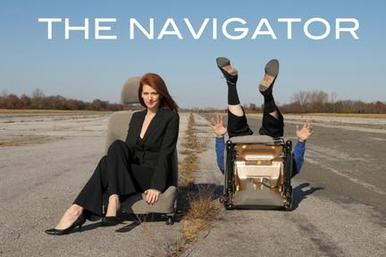
But what if your GPS could tell you more than which road to take, which exit is best, or which alternate route to use when you (despite its best advice) still managed to miss the turn? What if your GPS started telling you the answers to everything? Especially during a time when you don’t seem to have the answers to anything? This is the premise of Eddie Antar’s The Navigator – a show which originally was presented by The WorkShop Theater in 2010 as a Play in Process. It was so successful that it was nominated for multiple IT awards, won 2 (for Outstanding Direction and Outstanding Lighting Design) and is now being remounted February 9-March 3 as a full production. Continue Reading…
John Sowle in Horripilation! / Photo by Steven Patterson
The writer and performer of Horripilation!, John Sowle, is unquestionably a shining light in the fields of research and preservation of obscure global theatrical traditions, as well as being an imposing performative figure in the relating and embodiment of these same traditions. In 1973, with a Fulbright fellowship to research a doctoral thesis in dramatic art, he spent time at the Kerala Kalamandalam in southern India, where he was obliged to rise each morning at 3 a.m. in order to begin his day’s grueling training in traditional dance movement and actorly craft. Kept on his feet for hours at a time, in a highly repetitive form of dance stepping, his relief would come finally in the form of a massage administered by his teacher (asan), who would walk up and down his back while he lay in a formally controlled position. It should come as no surprise that classical traditions of drama and dance, wherever they originate, involved a regimen of severe physical hardship and mental discipline, but the sharing of these events in the performance by Mr. Sowle, as he reproduces the exercises nearly forty years later, is quite something to witness.
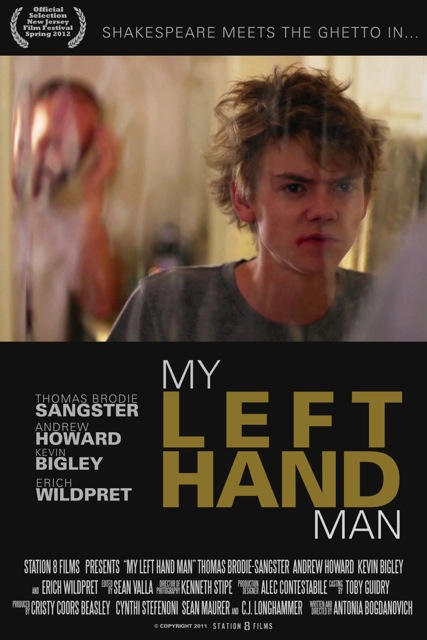
I was lucky enough to get a sneak peek at the new short film by Antonia Bogdanovich — MY LEFT HAND MAN — starring Thomas Brodie-Sangster (Nanny McPhee, Love Actually), Andrew Howard (Limitless, upcoming “Hatfields and McCoys”), Kevin Bigley (“The Chicago Code,” “CSI: Miami”) and Erich Wildpret, who is a Latin American star. The 18-minute dramatic short screens as part of the NJ Film Fest at Rutgers on January 28th. Although the film clocks in at under half an hour I was captivated by the beautiful mosaic of emotions Bogdanovich was able to create both as writer and director in this film. The story is told in a straightforward, simple manner however the situation is anything but conventional.
The Emersons are a theatrical family, of sorts – one son is a street performer who recites Shakespeare while his older brother picks pockets in the crowd. Their father, a has-been thespian, spends the take on booze and ponies. But Samuel wants to make like his comic book hero The Cardinal Comet and split; and a visit from a loan shark gives Samuel a chance at freedom.
Ms. Bogdanovich graciously allowed me to pepper her with questions, both about this amazing film and the process of making it, as well as how her impressive lineage played a part in making her who she is today. Read on as she tells me about the challenges of creating a short film, how her own rebellious youth helped her created the character of Samuel, and exactly what a “left hand man” means to her …
Antonia Bogdanovich
Antonia! I just saw your short film, MY LEFT HAND MAN, and found it incredibly compelling. In 18 minutes you manage to tell a story which provides so much back-story yet takes place in a very short span of time.
You not only directed MY LEFT HAND MAN, but wrote it as well. Where did this idea of the story come from?
Antonia Bogdanovich: The idea came from a few places. I love Shakespeare – as an actor, I studied it a bit at the Royal Academy of Dramatic Arts in London (summer program). And I have seen quite a few very good productions on stage, as well as some of or most of the films. I really relate to his work, it has such depth yet it is so accessible. The crime elements are from my own experiences….ahem… I was a bit of a juvenile delinquent – rebelling pretty hard against my upbringing. So I basically hung out with kids that stole cause they had to (their parents didn’t have enough to finance their extracurricular activities) or because they just liked the thrill of getting away with it or both.
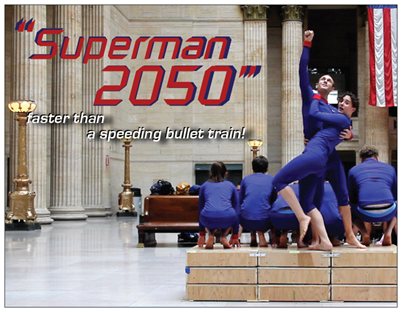
Deploying a short and narrow raised, wooden platform, with a total area surface of 21 square feet, seven actors in blue spandex outfits (that’s 3 square feet each they have to work with; you do the math!), no scenery or lighting effects, and just 35 minutes, Theater Un-Speak-Able set out to tell that well-worn saga of our age, Superman, transposing it to the year 2050. No actor gets to leave the platform during the telling. All of the fantastical visual effects necessary in the elaboration of this story – illustrated comic book panels, complexly designed camera shots – must be generated solely by the actors as they shuffle, dip, duck, dodge and dive while dramatizing such a highly visual narrative. This is both extreme physical performative stagecraft and compacted theatrical story telling.
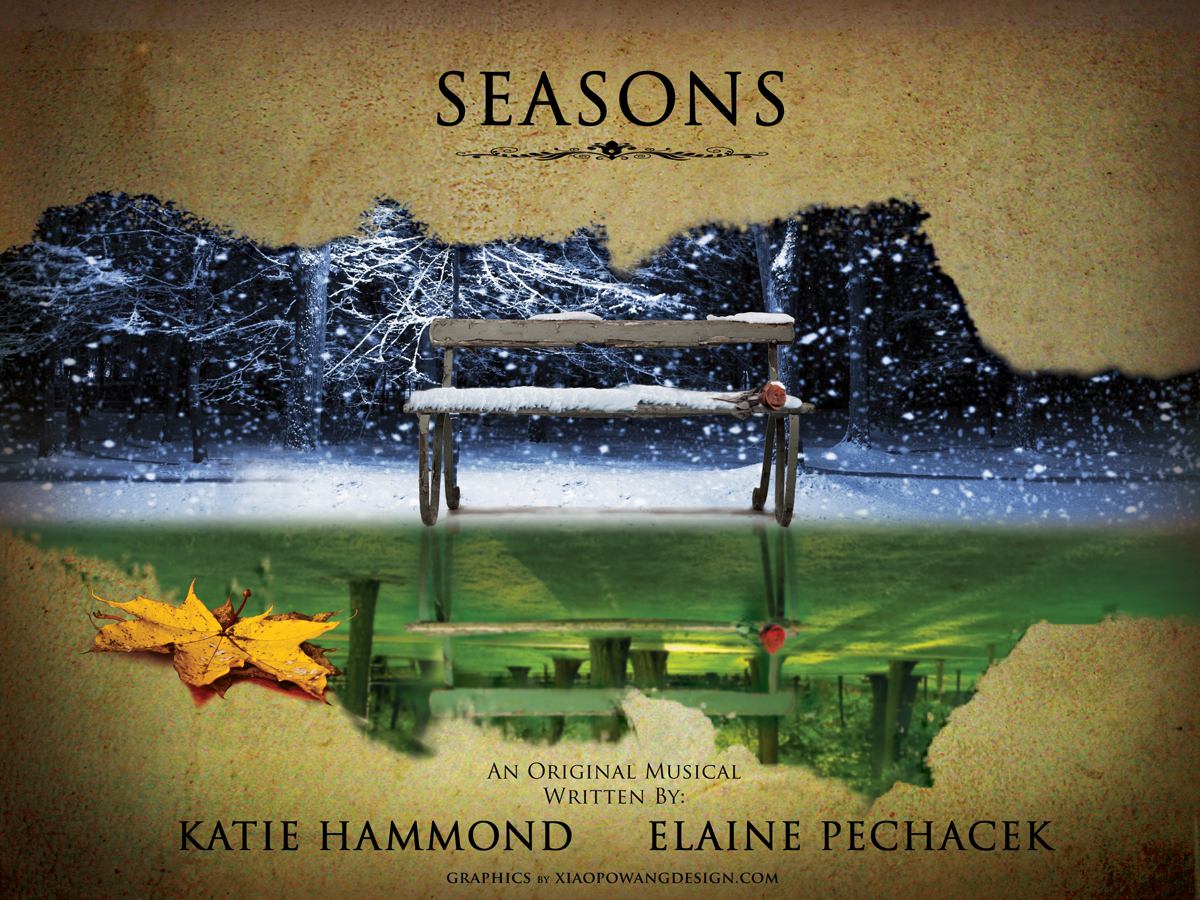
It isn’t easy to tell an entire story without one word of spoken dialogue, let alone give proper attention to two concurrent plots that run simultaneously but never intertwine, except emotionally. Yet SEASONS does just that, and with such deep resonance that sold-out houses were sobbing as they watched the four central characters of Elaine Pechacek and Katie Hammond’s original musical live through one very specific year that, for them, was filled with love, joy, regret, confusion, despair, birth, and death. Continue Reading…
“There is failure and there is success. What better way to measure this than the piano?”
If you were the child who spent your afternoons inside practicing the piano (or another musical instrument) while you could hear other children running around in the sunshine you no doubt have an ache in your heart when now, as an adult, you hear other people discussing their memories of playing in the streets, or even watching endless hours of after-school cartoons. Sure, you may have agile fingers which allow you to type an error-free 75 WPM but aside from that, are you really any better off? Was it worth it?
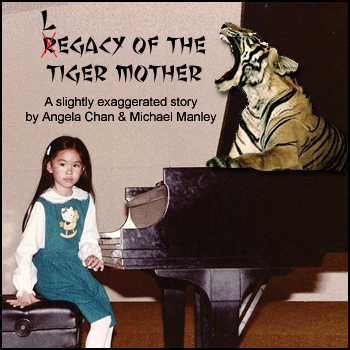
Let’s take it one step further. Imagine you are Mei (Lynn Craig), grown daughter of Lily (Satomi Hofmann), who monitors her daughter Kim’s practicing from the other room. Distractedly tapping away on her blackberry she suddenly hears the words of her mother boom from her own lips as Kim prepares for recital day: “You will practice that piece until you can play it 20 times perfectly!” Stunned, Mei realized she has stepped up and taken on the Legacy of the Tiger Mother.
Isramerica Production
Conceived and Created: Sivan Hadari
Directed and Co-created: Charlotte Cohn
While sharing their own personal experiences and real life stories, ten actors haling from diverse cultural backgrounds (American, Asian, African, Israeli, Palestinian, Latin) explore the deep rooted connection they all have with “longing”.
Show Times:
Wed 1/18 @ 10:00pm
Sat 1/21 @ 10:00pm
Sun 1/22 @ 6:00pm
Answers by Sivan Hadari – Creator/ Producer
Karen Tortora-Lee’s Question
This is an international festival. What part of the world are you coming from … and will your show tantalize the NYC audience with a taste of your nation’s culture? Sivan Hadari: I am an Isramerican. Born in Brooklyn, raised in Israel and now back in New York. The actors in our cast are from Japan, Israel, France, The Philippines, USA, Kyrgyzstan, China and Singapore.
While sharing their own personal experiences and real life stories, twelve actors hailing from diverse cultural backgrounds explore the deep rooted connection they all have with “longing”. We will hear their tales of unrequited love, separation, heart-break, mourning, homosexuality, religion and faith while they draw inspiration from the story of Israeli soldier Gilad Shalit who was held captive in Gaza by Hamas for 1,934 days.