by Karen Tortora-Lee on December 7, 2010

*All photos in this article courtesy of Stevyn Llewellyn.
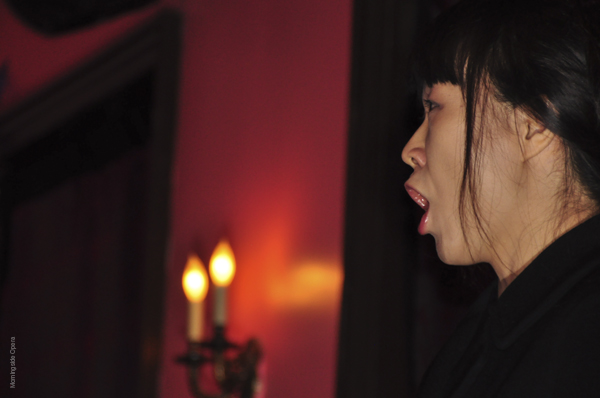
What do you get when you mix up a bunch of people who can sing karaoke better than the average bar crowd, background tracks that runs the gamut from Bizet’s Carmen to Gershwin’s Porgy and Bess, with a smattering of Rogers and Hammerstein, Irving Berlin and Handel thrown in, and a gorgeous gal who strips down to her pasties? Not to mention – well, actually – do you need more than that?
Continue Reading…
Related Posts:
by Karen Tortora-Lee on March 12, 2009

Cherubino: Kathryn Lawson / Susanna: Gillian Wiggin / Count Almaviva: Ralph Petrarca Photo courtesy Ryan Baxter
I’ve loved the opera since I was a little girl; my parents had a pair of season tickets to the Met since I was twelve and I’d go whenever the seats were offered to me. Aside from the time I was sixteen and my friend and I ditched La Boheme to go shoe shopping on 8th Street instead (hey, I was SIXTEEN!), I always looked forward to going to the Opera no matter what was playing. I’ve seen all the big ones several times over, and when I wasn’t at the actual opera with one of my parents I was watching it on PBS, or listening to records that popped and hissed with overuse (yes, that’s how it was back then). “How did that get in there?” I said, frozen in fear in the middle of Kings Plaza when the bag I was trying to pass off as crammed full of Donna Summer records was discovered to actually be filled with the likes of Renata Scotto Sings Verdi and Madama Butterfly highlights by my sixth grade “cool” friend. It was a Lisa Simpson moment before Lisa Simpson even existed.
When the movie Amadeus came out I was transfixed; it was the first movie I bought on VHS and I watched it so often that I can do entire scenes word for word. So it’s no wonder that The Marriage of Figaro is dear to my heart. I’ve seen both the traditional version as well as the Peter Sellars version (set in the Trump Tower). So when I heard that Figaro/Figaro was being done I was intrigued; Eric Overmyer’s Figaro/Figaro is an adaptation of Pierre Beaumarchais’ The Marriage of Figaro (the same play upon which the opera is based) and Odon von Horvath’s Figaro Gets a Divorce … or rather Figaro läßt sich scheiden; the original play was written in German. To me it sounded like it would all play out as a dark fairy tale; Cinderella when reality set in …
Continue Reading…
Related Posts: