by Karen Tortora-Lee on August 11, 2011


Redd Tale Theatre Company has a knack for taking well-worn stories and delivering them with a fresh perspective. Currently during their “summer of creation” they are exploring the themes of what it means to be human and how our need to connect on a deeper level drives all living creatures. By currently pairing a well-known and time-honored old fashioned horror story – Frankenstein – with a newly written modern sci-fi piece – Gabriel – this talented ensemble is virtually flipping a coin for us and showing two sides of a very complex issue during one ambitious night of theatre.
Continue Reading…
Related Posts:
by Karen Tortora-Lee on August 16, 2010
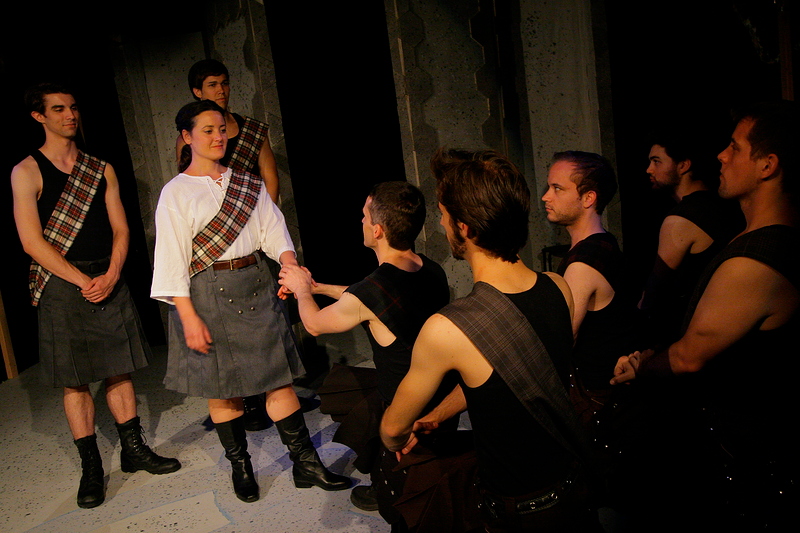
Cast of Macbeth (photo by Ben Strothmann)
This may not be a popular theory, but I always felt that if Shakespeare were alive today and writing this Scottish play the plot might very well be the same . . . but the title would be Lady Macbeth and the emphasis would be completely different. For without the devious, devilish, deliciously deceitful Lady at his side Macbeth would be just another Hamlet, wandering about the castle wondering when his future was ever going to relieve him of his everlasting present.
Director Will Le Vasseur has done two things with Redd Tale Theatre Company’s Macbeth that I applaud him for. One, he’s “tightly edited” the original Shakespeare in ways that leave the story in tact while still getting the audience back on their feet before numbness sets in. However, the bigger triumph lies with point two. What Le Vasseur has done here – which I have yet to see done in other productions – is give this traditionally male-dominated Shakespearean Tale to the women. He’s managed to make a Feminist Macbeth. Now if I could only lobby to get him to change the title . . .
Continue Reading…
Related Posts:
by Karen Tortora-Lee on August 10, 2010

Take a cross dressing princess who woos everyone in her path in order to be with her true love, add a philosopher whose cerebral journey allows no room for romance, mix in his spinster sister who’s been shut away in a lonely compound full of men but with no opportunity, throw in a young man whose throne has been stolen from his family and who’s been raised to think women are the enemy, drizzle it all with the broad antics of comedic sidekicks and what do you get? Pierre Carlet de Chamblain de Marivaux’s farce Triumph of Love . . . written in 1737. But don’t let the 300 year old time stamp deter you - Redd Tale Theatre company has a new adaptation in store for audiences, with a new translation by Virginie Maries and a bit of a sci fi twist as well, courtesy of director (and adapter) Will Le Vasseur.
Continue Reading…
Related Posts:
by Karen Tortora-Lee on August 12, 2009
Society doesn’t look kindly upon mothers who kill their children, intentionally or otherwise; right now the court of public opinion is busily vilifying Diane Schuler who was reportedly drunk and stoned when she piled a group of children (her own daughter included) into her car and then drove the wrong way on the Taconic State Parkway killing everyone as well as (some would say rightfully) herself. Before that, there was the infamous Andrea Yates, who, in a stupor of post-partum depression and psychosis, systematically drowned one child after another until all 5 of her young boys were dead. But really, the “how” is never the question. In fact, the “how” is pretty much shushed away quickly, no one wants to hear how a mother kills her own children. What we are left asking is … why? Why would a mother kill these little ones?
The Greeks have always been amazing storytellers; their myths and tragedies are rife with the themes that pulse through every level of society. Show me an Icarus and I’ll show you a victim of Bernie Madoff. But the story of Medea has always been a little harder to figure out; a woman who is so angered by her husband’s betrayal that she kills her sons in order to exact revenge on him. Again, this “why” never quite resonated enough with me to be clearly understood. A woman can more easily identify with killing herself over a tragic affair than she can with killing her own child. So updating Medea has to be done very carefully. Luckily, playwright Will Le Vasseur has found a way to give his Medea the perfect out, thus preserving the original story while making his main character actually sympathetic. Continue Reading…
Related Posts: