by Karen Tortora-Lee on May 8, 2012


There’s a reason that the second rule of Fight Club is the same as the first rule of Fight Club. Because Tyler Durden (and by extension, author Chuck Palahniuk) understood that it’s human nature to break rules. First rule of Fight Club – don’t talk about Fight Club. Second Rule of Fight Club: DO NOT talk about Fight Club. So what did people do?
What does this have to do with August Schulenberg’s new play DEINDE? Simple. DEINDE – a sci-fi story of quantum biologists who use a Dineural Entangled Intelligence Network DEvice [a "clumsy acronym, really, not even a real E at the end"] to “loop in” in order to juice their brains so that they can be smart enough to cure a virus that has been killing the world’s population – begins with four simple rules:
- When using DEINDE do not think of anything other than work.
- Do not keep the connection to DEINDE live outside of work.
- Do not use DEINDE to communicate with each other.
- Do not use DEINDE to accss the world online.
Sounds so easy to follow, right? So did “Don’t talk about Fight Club” and we all know how that turned out.
Continue Reading…
Related Posts:
by Karen Tortora-Lee on February 28, 2012


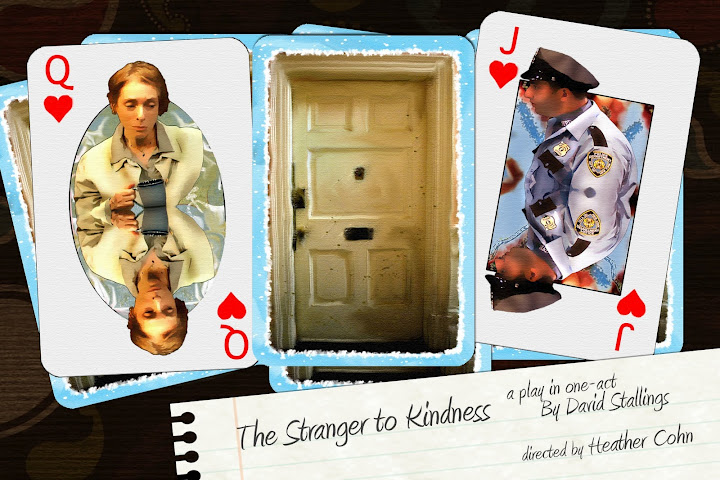
More often than not, when the question of “how do you want to die” comes up the answer is often “in my sleep” or “surrounded by my friends and family”. The hope of most human beings is that, when it’s our turn to check out, we do so peacefully and with someone caring by our side. In David Stallings’ The Stranger To Kindness (directed by Heather Cohn) now playing as part of The 2012 Frigid Festival we see what happens when neither choice is available.
Continue Reading…
Related Posts:
by The Happiest Medium on February 7, 2012

Five Questions. Five Answers. And One Big Decision: Rock, Paper, Or Scissors?

The Stranger To Kindness
Company: D&A Productions
Directed by: Heather Cohn
Years of routine bind Lena and Nance, two lonely senior women from the Upper West Side. When Nance no longer answers her door, Lena takes it on herself to call the police and her friend’s family. What arrives is a strange dose of animosity and generousness from unlikely places.
Show Times:
- Thu 2/23 @ 6:00pm
- Sun 2/26 @ 2:30pm
- Wed 2/29 @ 9:00pm
- Thu 3/1 @ 7:30pm
- Sat 3/3 @ 4:00pm
Answers by Antonio Miniño
(Performer)
Karen Tortora-Lee’s Question
That’s some title. How did you come up with it – and what does it mean?
Antonio: The title is a play on words from the famous final lines of A Streetcar Named Desire, “I’ve always depended on the kindness of strangers”. The characters in The Stranger to Kindness are all figuring out what kindness means, how to give it and how to accept it from others, especially strangers.
Continue Reading…
Related Posts:
by Karen Tortora-Lee on January 29, 2012


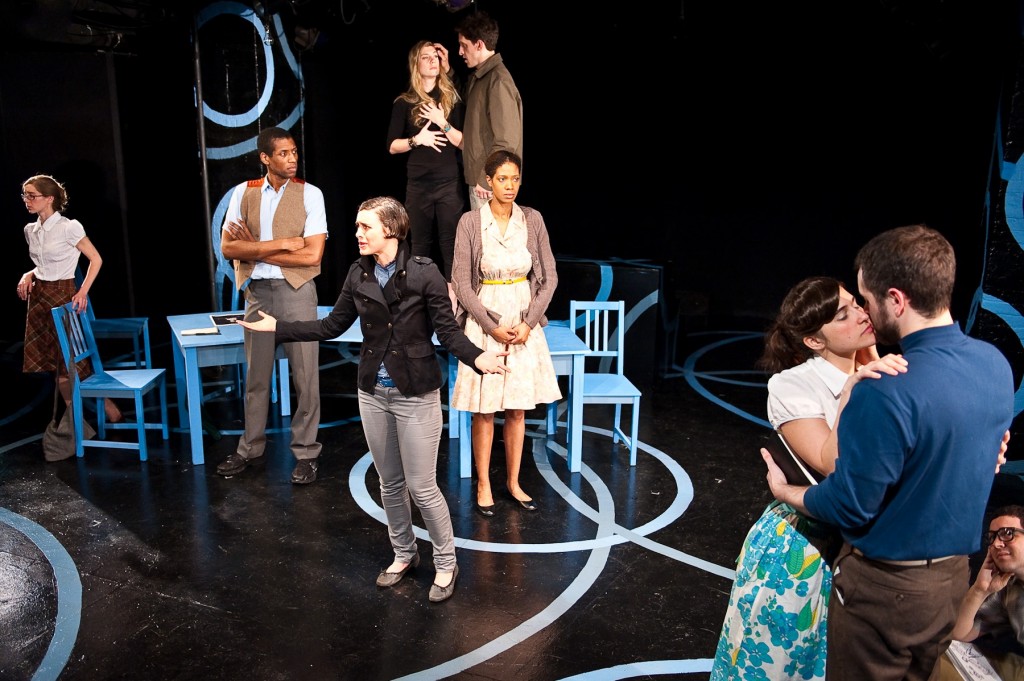
Flux Theatre Ensemble’s production of Menders (written by Erin Browne and directed by Heather Cohn) currently playing at The Gym at Judson will catch you by surprise – but not all at once. It will do so in subtle ways, often, and always differently than it did moments before.
First you will be drawn in by the simple aesthetics of the piece, which unfolds with a wisp of mystery but a promise of payoff in the end because, of course, that’s the way all good stories wrap up. Not necessarily with a good ending, or a bad ending, but a powerful ending which simply means one interlude has come to its natural conclusion. Director Heather Cohn understands how to build the perfect scaffolding around this story, which is a story of stories — each story within it also coming to not a good ending, or a bad ending … simply a powerful one.
Next you will be moved by the poem Mending Wall by Robert Frost which is recited in part by each character in kind as they move about the stage and gather items, disappearing and reappearing from behind several substantial walls that dominate the set (beautifully and cleanly designed by Cory Rodriguez). You’ll know what they’re reciting if you’ve read your program cover ahead of time — if not, it will come up soon enough and the elegance with which the symbolism is used is exquisite; each time lines from the verse are repeated they catch your ear differently, each iteration vibrating with a deeper meaning of what it means to keep people out, or in, or know precisely which it is that is being done. I’m sure those who have already seen the show were quick (as I was) to sit with the poem and see it through fresh eyes.
Continue Reading…
Related Posts:
by Karen Tortora-Lee on November 13, 2009


Cast - The Lesser Seductions of History (Photo Credit: Tyler Griffin Hicks-Wright)
Watching the Flux Theatre Ensemble bring August Schulenburg’s “The Lesser Seductions of History” to life is like watching seasoned acrobats performing an intricate, balletic routine; one which -in order to succeed- relies on trust, timing, and blind leaps of faith … knowing that your fellow performers are exactly where they should be and will deftly handle the assist, even as they fully commit to the leap they are taking themselves. One miscalculation and the whole thing comes tumbling down, and then forget about the net. But no one here falls; in fact, they soar. The thrill of watching this seasoned group of actors move between each other and react off one another with precisioned timing is what makes Lesser Seductions so … well … seductive.
Continue Reading…
Related Posts: